
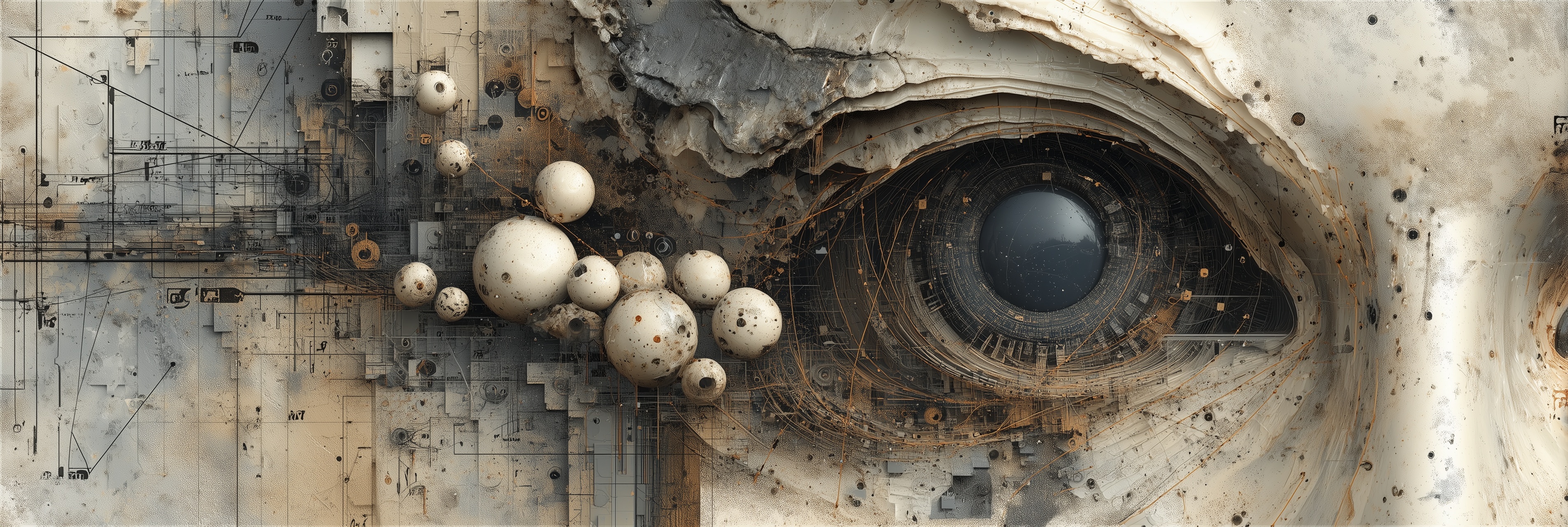
Pearls form when a mollusk envelops a foreign body, such as a grain of sand, with successive layers of nacre. It is the creature’s defense mechanism, but we look at it and call it a jewel.
I want to begin with this image because it describes very well a type of cognitive phenomenon that seems central to me both to the discussion of artificial intelligence and to the discussion of ourselves.
First there is a disturbance. A grain... or a symbolic inclination. Something small, still without full form, but enough to trigger a process. Then come the layers: memory, context, local coherence, affect, language, explanation. In the end, what appears to us is already a ready-made pearl, polished, bright, elegant. The question is simple and uncomfortable: what came first? Reason or nacreization? The grounding or the conclusion?
The transition between this metaphor and language models needs to be made carefully. Not because it is fragile, but because it can be misunderstood. What is at stake is not saying that a language model “has pearls in its head,” nor that the human mind and the machine are the same thing. The point is another: in both cases, there may be an important difference between the moment when an inclination stabilizes and the moment when a narrative begins to justify it.
This is where the paper that triggered this text comes in: Therefore I am. I Think. The article investigates a direct question: in reasoning models, does the choice come after visible thought, or does the more primitive inclination toward the choice already arise before that, with a narrative later adorning it in the form of a justification? Within the experimental scope of the paper, the authors show evidence that, in tool-calling tasks, the decision may be encoded before the visible chain-of-thought, and that the subsequent reasoning often functions more as a rationalization of an already inclined trajectory than as the actual origin of the decision.
This is embarrassing.
But, in my view, it is not embarrassing for language models.
It is embarrassing because of the way the human mind seems to work.

The real embarrassment is not in the machine
Human intuition establishes that analysis should come first, then deliberation, then conclusion. First facts, evidence, context. Only then the proposal... the proposition. The paper suggests that, at least in certain cases, that is not how it works even for systems we now tend to call Reasoning models. In some circumstances, the model already seems to lean toward a choice before it starts thinking in text; the text comes afterward, as explanatory ornament... as justificatory varnish.
In other words: the conclusion may precede the grounding.
Except that the deeper shock, in my view, does not lie in the fact that language models may operate this way. The shock lies in realizing how much this resembles what happens inside the human mind.
Our deepest conclusions are rarely born of pure reason. They begin as a disturbance: a grain of sand. A primitive inclination that is not yet exactly a decision or a conclusion, but a less sophisticated shadow of both. A kind of intuition. A probabilistic attractor. Something still without full form, but already enough to set one or more processes in motion.
This inclination keeps rolling through the mind. It gains layers of memory, affect, bias, language, context, identity, convenience, self-preservation. And these layers keep sedimenting until the grain of sand becomes a pearl.
And that pearl is our opinion.
The polished conviction. The position that swears it was born of analysis, when analysis often came after it.
This inversion between conclusion and grounding is not merely an elegant image. It finds support in a very serious tradition of cognitive psychology. Richard Nisbett and Timothy Wilson argued, back in 1977, that human beings often do not have reliable introspective access to the higher-order mental processes that produced their judgments and choices and that the accounts they give afterward tend to take the form of plausible explanations, not necessarily a faithful representation of the genesis of the process.
Decades later, choice blindness made this even more uncomfortable. In the classic experiment by Johansson and colleagues, participants often failed to notice that they had been given, as their own, a choice they had not made, and still produced articulate justifications to defend it (Petter Johansson/Lar Johansson, 2005). In later work (2006), the same authors deepened this line by showing how little the verbal form of these justifications differed between genuine choices and manipulated choices.
Put in my own way: the human mind often does not deliver us the process... it delivers us the finish.
The access we have to ourselves is often subsequent, interpretive, and limited. The language model does not know from which embedding the response came. The human being does not know from which subpersonal depth the conviction came. In both cases, what first appears to the accessible surface is not the raw mechanism, but the symbolic echo of what has already consolidated in latency.
And that may mean that much of what we call “reason” may, in many contexts, be the nacre of the decision.

Neither the whole brain, nor a fragile metaphor
This is where I think it is important to establish a more defensible formulation of the analogy.
Language models are not analogous to the whole brain, but to certain functional strata of human cognition, especially those linked to the emergence of semantic inclinations, the probabilistic stabilization of responses, and the discursive narrativization of those inclinations.
This formulation matters because it avoids two opposite errors.
The first is to anthropomorphize the model excessively, as if it were a complete human mind waiting to “awaken.” The second is to reject any serious analogy just because the biological substrate is different from the computational substrate. In my understanding, that is fallacious... a false dichotomy. If the criterion is functional, it does not matter that the brain has blood and lungs and the car has pistons and fuel. What matters is the functional role performed within the system.
In that sense, the analogy is not fragile. It is simply partial.
The foundational model seems to concentrate, within a single architecture, something that in the human is distributed: probabilistic tendency, semantic stabilization, and narrative production. In the human being, on the other hand, these primitive inclinations may enter a broader circuit with autobiographical memory, conflict monitoring, executive control, abstraction, methodical discipline, social context, and metacognition. In other words: in the human, the relationship does not always proceed linearly from primitive intuition to narrative creation, because other layers may enter the process (or the feedback loop) and revise, delay, correct, contradict, or dismantle the pearl before it consolidates.
That is why the attempt to mention the supposed nuance of the divergence between the human brain and language models is asymmetric.
It does not invalidate the analogy; it defines its architectural limits.
And precisely because of that, it would not be fair to evaluate language models in the same way that we evaluate a complete human mind. By technological contingency, they were not built that way.

Reasoning does not hover above the model
More recently, models have gained reasoning. They began to exhibit chains of thought, deliberative simulations, intermediate reasoning steps, local revisions, explicit hesitations. That matters. But it also needs to be seen without naivety.
Reasoning does not hover above the model as if it were a pure instance of reason. It is born already traversed by the base context, the foundational weights, the training history, the conversation in progress, at times by memories of other conversations, and by the distributions that make certain trajectories more probable than others. In other words: reasoning already enters the scene biased by the very terrain on which it operates.
What does that mean?
That, when we introduce explicit mechanisms of reflection, checking, or revision into the generation process, we are trying to insert method into an architecture that, from the outset, remains biased and probabilistic. The very fact that we need to do this already reveals the problem. Reasoning does not eliminate the need for a framework; it makes it more visible.
Specific methods enter precisely there, within or around reasoning, to try to articulate questioning, restraint, revision, contrast. And this is already, in essence, what I am calling framework and tools.
Good methods are not there to protect the pearl. They are there to crack it... to deconstruct it.
Bad methods give varnish to what you already wanted to be true. Good methods ask: is this authentic? Or is it just an old error that calcified and now gleams? Is this a robust conclusion or merely an attractor well dressed up as an argument?
In the human being, this may take the form of methodological rigor, critical thinking, abstract reasoning, logical revision, honest counterposition, and conceptual discipline. In artificial systems, this does not arise spontaneously from well-formed text. It has to be architected.
From topology to the agent
That is why, in my view, the most promising solution does not lie in waiting for the foundational model to solve on its own the problem of its own inclinations. Nor does it lie in depending indefinitely on the frontier labs so that, version after version, they try to embed ever more sophisticated corrections inside the model itself.
The most fertile solution seems to me to be another: to build topological frameworks and tools around the model.
Not inside the foundational model, but in the topology of the chatbot or of operational environments built around these models.
It is in this space that persistent memory, maintenance of meaning over time, regulated counterposition, independent revision methods, measured subjective criteria, abstract reasoning, critical re-entry, and methodological rigor come into play. It is there that something functionally analogous to the human layers that not only narrate but also revise the narrative can be instituted.
When that happens, we are no longer speaking only of a language model. We are speaking of an Agent.
Agent, here, not in the banal sense of “a model that calls tools,” but in the more demanding sense of an architecture capable of sustaining continuity, coherence, revision, and meaning over time. A system in which the response does not end with its local plausibility, but can be returned to independent and regulatory methods that act as brake, contrast, criterion, and maintenance of truth.
It is precisely because they are analogous only to these functional bands, and not to the complete cognitive architecture, that language models need an additional framework of memory, method, revision, and counterposition.
Without that, the most we can achieve are bright pearls produced by a pearl bay that is not very fertile in nutrients.
With that, perhaps we may begin to cultivate something more interesting: systems capable of maintaining meaning, revising inclinations, and submitting their own conclusions to methods of deconstruction.
Perhaps mature intelligence, in us and in machines, is not the capacity to produce convincing answers.
Perhaps it is the capacity to prevent the shine of the pearl from replacing the work of Truth.

One last caution
These observations do not authorize interpretive or triumphalist exaggerations. The most recent literature has also shown that human introspective access is not always as poor as certain maximalist readings suggest. There is recent work (A.Morris et al., 2025) indicating that, in multi-attribute evaluative choices, people sometimes have more access to their own decision processes than the more skeptical tradition had imagined.
In my view, that does not weaken the thesis. It only makes it more honest.
The point is not to say that the human being always concludes first and justifies afterward. The point is to recognize that, in many relevant domains, the relationship between conclusion and grounding seems to be less linear, less transparent, and less honorable than we like to believe.
And perhaps that is precisely why this paper about language models is so embarrassing.
Not because it reveals a defect exclusive to machines.
But because it forces us to face an uncomfortably familiar trait of our own way of thinking.
Would you like to know more about my research?
Stochastic Consciousness:
Architectures for the Emergence of Meaning
in Context-Sensitive Language Systems
https://zenodo.org/records/19188165
Do you want to watch the video?
https://www.youtube.com/watch?v=MsVYzBYLSFE
Do you want to listen to the podcast?
Paper discussed in this article
Therefore I am. I Think